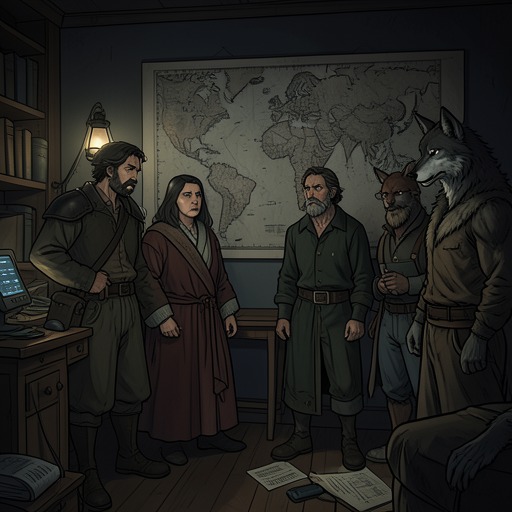
Samsa ranch compound
Insatiable Box Set: Books 1-4Samsa ranch compound is the central estate of the Samsa family and the main physical expression of their attempt to turn a werewolf pack into a durable household. It is where Adrienne Ward lives with the Samsa triplets and their children, where the brothers negotiate marriage and pack law, and where human caregivers must work under conditions of secrecy. The compound therefore joins domestic intimacy to territorial sovereignty: it shelters the family, but it also exposes the family’s dependence on Adrienne Ward’s fertility and makes the household a strategic prize in the conflict between werewolf packs.
Setting and Function
The compound is presented as a large ranch home shared by Adrienne Ward, her two sons by Wilder, and the Samsa triplets. When Adrienne Ward returns by limousine after becoming overwhelmed by the crowded emotional and familial situation surrounding Wilder, Drayton, Lycell, and the children, the house is the place she expects to find Hunter Samsa and Devin Samsa. Instead, two tall, muscular blond teenagers stand in the foyer, revealing how quickly the children have grown and how radically the household has changed while she has been away. Her arrival turns the ranch from a remembered residence into a site of disorientation, reunion, and accelerated werewolf family life.
The compound also stands in contrast to Adrienne Ward’s earlier isolation on the road and in the wilderness. Her drive from Sacramento, California toward Lake Tahoe takes place at night, at an elevation of six thousand feet, through heavy snow and on a slippery road without snow tires. After her car tumbles into the earth and disappears, she must walk through the forest and sleep under leaves and pine limbs. The ranch, by comparison, represents shelter, resources, recognized kinship, and organized care. Yet the contrast is not simply between danger outside and safety inside: the ranch’s secrecy, hierarchy, and rules create their own forms of constraint.
Household, Nursery, and Care
The nursery is one of the compound’s most important spaces. When Adrienne Ward asks Drayton to help with the babies while Wilder withdraws into the woods, Drayton takes her to the nursery, where Robert is examining the pups and Mena is rocking one of Adrienne Ward’s six young. The scene establishes the estate as a collective-care institution rather than an ordinary private home. Children are handled by fathers, allies, medical personnel, and paid nurses, while the adults’ disputes continue around the demands of feeding, supervision, and protection.
The compound’s secrecy limits the household’s access to ordinary human services. Drayton explains that nurses from outside Samsaville cannot safely be called in because the family’s werewolf identity must remain hidden. The estate consequently requires a controlled labor system: nurses who already understand enough to serve the family remain on the grounds, and Drayton promises to help Adrienne Ward at night after the nurses leave. One nurse, whose husband is dead and whose children are grown, accepts the work because she has little else to occupy her and hopes to care for more of the Samsa children. Her response shows how the ranch absorbs human labor into a concealed werewolf domestic order.
The nursery is also a political resource. Lycell asks the nurses to remain on the compound until he returns and instructs them to care for his sons, offering substantial payment for their time. The request follows the revelation that the Samsa family depends upon Adrienne Ward and the young boys for the pack’s future. The babies are not merely members of a household; they are the demographic answer to a population crisis in which many werewolf females are sterile and rival packs are shrinking. Their care inside the compound is therefore inseparable from succession, territorial survival, and impending war.
Law, Marriage, and Authority
The estate operates under overlapping legal systems. Wilder insists that he is the Alpha male of the pack and that Adrienne Ward is his mate, while Adrienne Ward ultimately demands marriage to Wilder, Lycell, and Drayton. Her request transforms the compound into the setting for a negotiated human-werewolf marriage arrangement rather than a simple private romance. The brothers’ shared pact allows Wilder, as head Alpha, to select a woman whom all three will accept and mate with; if Wilder dies, the next brother in line is expected to take and marry her. The estate thus houses a family structure governed by succession as much as by affection.
That authority is challenged when Ramsey, Mena’s father, confronts Wilder at the compound. Ramsey accuses Wilder of breaking a promise to arrange Mena’s marriage to one of the Samsa brothers and objects that a human woman has been allowed to dictate werewolf law. Wilder responds that Ramsey has entered his home and spoken disrespectfully about his mate. The argument makes the ranch a jurisdictional boundary: outsiders may bring claims to its door, but Wilder treats the compound as territory under his authority, where the status of Adrienne Ward and the rules of the Samsa household are not open to external command.
The conflict over Mena cannot be resolved by romance alone. Wilder tells Drayton that he must mate with Mena, explaining that the purpose is to prevent war rather than to satisfy love. The Alaskan and Oregon packs have joined forces and possess greater numbers than the Samsas, while old grievances and broken marriage expectations threaten to turn the dispute into open violence. Later, Wilder sanctions the marriage of Robert and Mena and links it to the planned marriages of Drayton and Adrienne Ward. The compound therefore serves as a council chamber in which marriage is used to stabilize alliances, incorporate a human doctor, and protect the pack from retaliation.
Fortress Under Threat
Although the compound is a home, it is never politically neutral. Rival packs understand that the Samsa family’s strength depends upon its children and its human mate. Bane’s abduction of Adrienne Ward and the larger hostility toward the Samsas expose the estate’s vulnerability: its population strategy is concentrated in a small number of people, especially Adrienne Ward and the sons who can continue the lineage. Wilder’s legal authority extends across a vast werewolf territory, but the ranch remains the intimate center that enemies can destabilize by taking one woman or threatening one nursery.
The danger becomes immediate when Drayton returns to the ranch after Adrienne Ward and Mena have disappeared. He rushes through the foyer after hearing babies crying and calls for Adrienne Ward, while Lycell appears carrying one of his sons wrapped in a blanket. The juxtaposition of infant care and emergency alarm captures the compound’s double identity. It is a domestic space filled with ordinary cries and parental gestures, but those sounds coexist with abduction, pursuit, and the possibility of inter-pack war.
The estate’s defenses also depend on secrecy. Human police are considered inadequate against werewolves, and involving local authorities could endanger the people of Samsaville. Wilder’s laws, the pack’s secrecy, and the family’s control over access to the compound are treated as necessary protections. At the same time, these rules place people such as Adrienne Ward within a system whose protections are inseparable from Alpha power. Bane’s treatment of Adrienne Ward in a remote cave makes the contrast stark: he binds her hands, ankles, and waist to a crude chair and tells her that an animal might eat her if he does not return. The compound is not equivalent to that cave, but both spaces reveal how safety and captivity can be defined by whoever controls the territory.
Narrative Significance
Samsa ranch compound is the novel’s most concentrated image of human-werewolf integration. It gathers human marriage customs, werewolf mating laws, Alpha hierarchy, medical care, reproductive planning, secrecy, and childrearing into one setting. Adrienne Ward’s insistence on marriage, the brothers’ shared commitment to remain together, Robert’s incorporation into the household, and the nurses’ work with the pups all show the estate continually translating between human and werewolf institutions.
Its importance also lies in the tension between belonging and control. Wilder tells Adrienne Ward that she may come and go, yet insists that she cannot take the child if she leaves while pregnant because the heir would be endangered. Adrienne Ward can become the center of the family’s future, but her movement is interpreted through pack law, reproductive necessity, and threats from the Ari Kara clan. The compound’s domestic order promises protection while defining the conditions under which protection is granted.
By the later conflict, Wilder is responsible for enforcing werewolf law over a pack stretching from the Americas to Russia, and Bane’s seizure of an Alpha’s mate becomes an offense demanding werewolf punishment. The ranch is the local, material point from which that wider legal and territorial order is imagined. It is simultaneously house, nursery, council, inheritance system, refuge, and vulnerable stronghold. Its decisive significance is that the Samsa family’s future is not abstractly located in lineage or law; it is embodied in the people gathered inside this compound and in the fragile domestic arrangements that keep them together.